Tree › Beryl Mann
Beryl (Yissachar Dov) Mann
יששכר דב · Yissachar Dov; Berl or Beryl in Yiddish; “Bertold” on a Polish card
Great-grandfather (Bubby’s father)
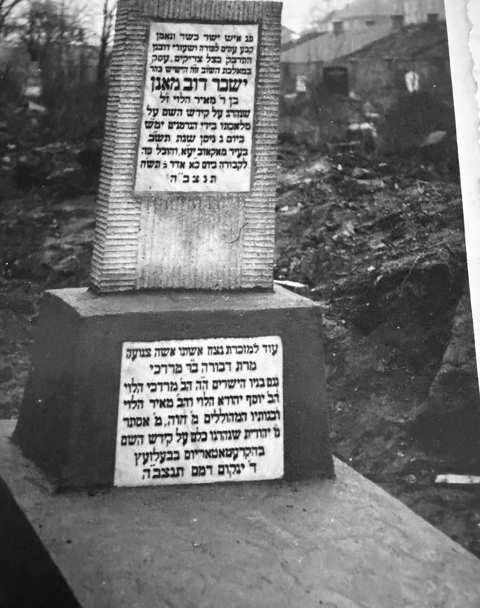
Bubby’s father was not a rabbi, but he was the posek of the small Jewish community of Maków: people brought him their questions. The family remembers him as a Sanzer chassid. His gravestone says he was also the town’s shochet. He was killed by the Germans in Maków on 21 March 1942, and was brought to a Jewish cemetery for burial in March 1945.
Parents: Meier Mann & Toba Mundshtuk (Ruth’s tree; backed by Nathan’s records)
Brother: Nathan (Naftali) Mann of New York
Wife: Dora (Lehrer) Mann
Children: Golda and six others
Timeline
- c. 1890Born. Ruth’s tree gives 1890. UnverifiedSource: Ruth’s Ancestry tree
- 1914–26Father of seven children with Dora. Family storySource: Family list; Yad Vashem interview
- Sep 1939A friend urged the family to flee to Russia. It was Friday night, and he would not travel on Shabbos. By the time Shabbos ended, the borders were closed. Family storySource: Yad Vashem interview
- 1930sA Polish local history describes him: "Berl Mann worked as posek and shochet (slaughterer). Tall, slim, bearded. He lived upstairs in a house built by Natan Groner. He had a handsome wife; his daughters earned their living by sewing." It also names "Goldie Mann, daughter of the Maków shochet" as someone whose Polish, learned at a Polish school, saved her life. Record (my translation from Polish). The description comes from the unpublished memoir of Bronisław Drobny, a court clerk in Maków, which only the author holds.Source: Jadwiga Sobczuk, "Przyczynek do historii regionalnej – Żydzi na ziemi makowskiej," Zeszyty Naukowe WSTiE (Sucha Beskidzka) vol. 24, no. 2/2023, pp. 105–134, zn.wste.edu.pl/images/zn24.pdf, p. 118, footnotes 31–32 (Drobny memoir cited at fn 24, p. 115: "in the Author's possession") (article found by Bayla Meyers)
- 21 Mar 1942His gravestone: killed על קידוש השם (al kiddush Hashem) by the Germans on ג' ניסן תש"ב (3 Nisan 5702, Shabbos 21 March 1942) in Maków. RecordSource: family gravestone photo, sent by Jonathan, Oct 2026
- 21 Mar 1942The Gestapo took him from home. He was shot alone that night at their headquarters. Over the next weeks 33 people in all were killed there and buried in a church yard. Family storySource: Yad Vashem interview
- 6 Mar 1945His gravestone: “brought here for burial” on כ"א אדר, ג', תש"ה (21 Adar 5705, a Tuesday), which is 6 March 1945. Record The stone doesn’t say where “here” is. Bubby’s recording says the Jewish cemetery in Kraków, so Kraków is likely. My inferenceSource: family gravestone photo, sent by Jonathan, Oct 2026
- after the warReburied with the others in a Jewish cemetery. Bubby insisted on it before she would marry, and Shiek’s money paid for it. Family story Her Yad Vashem catalogue summary puts the reburial in 1946. Record Both conflict with the stone’s March 1945, and so does the family’s order of events (Shiek back from Germany, then the reburial, then the wedding in 1948). The stone records the burial date directly, so it is preferred, but this isn’t settled. My inferenceSource: Yad Vashem interview
Records
Notes
- The Manns were Leviim. Beryl’s own stone calls his father ר' מאיר הלוי, and the plaque calls his sons HaLevi. Record His brother Nathan’s gravestone also says “HaLevi,” which is consistent. Record The father’s name, Meir, also matches Meier Mann in Ruth’s tree. My inference
- Berl = Yissachar Dov (Bayla's question). No single document carries both names, but three records line up: Bubby's own Yad Vashem registration form names her father "Berl" and her mother Dora (Yad Vashem Survivors Registration item 12770344, searchable at collections.yadvashem.org); the Auschwitz death-book entry for her brother names his parents "Berl and Debora née Lehrer" (Klistała, Martyrologium, 2009, p. 240); and the family gravestone reads "Yissachar Dov Mann ben R' Meir HaLevi," shochet, killed in Maków 3 Nisan 5702. Same wife, town and trade. Record They are the same man: near-certain. My inference ("Berl/Beryl" is the usual Yiddish name for Dov, "bear.")
- He was the shochet. His gravestone says עסק במלאכת השו"ב. Record Ruth’s family had thought he was not a shochet, “but maybe.” Family story The stone settles it.
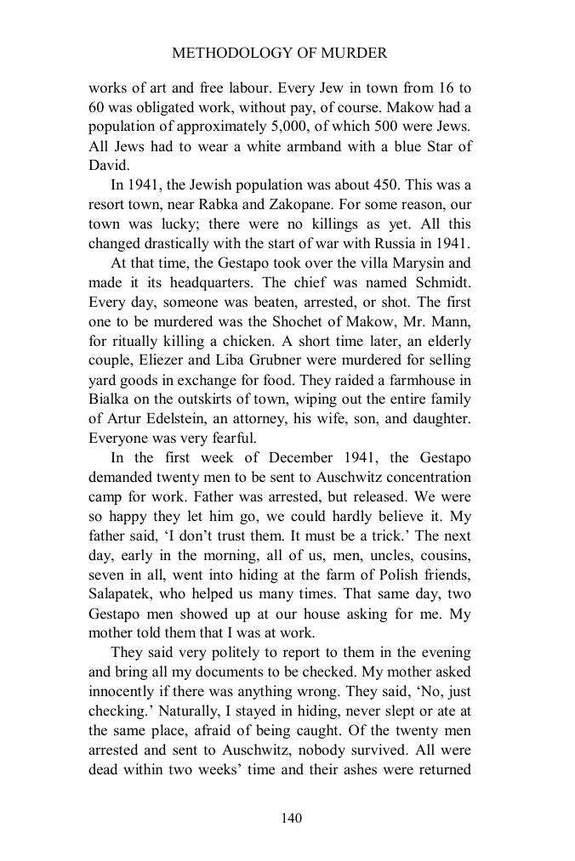
- A survivor from Maków, Arthur Kuhnreich, said the Gestapo’s first victim in Maków was “the Shochet of Makow, Mr. Mann,” in the villa “Marysin.” Record Since the stone confirms Beryl was the shochet, Mr. Mann is still most likely him. My inference
- Where the memoir conflicts. Kuhnreich gives no date, but the order of his account puts Mr. Mann’s killing in mid to late 1941: after the Gestapo took over the villa in June 1941 and before the December 1941 arrests. He says Mr. Mann was killed alone, as punishment for ritually slaughtering a chicken. The stone gives 21 March 1942, and Bubby remembered her father as one of 33 Jews killed there and buried together. Conflicting The stone and Bubby are preferred; the memoir was written decades later and its order of events is probably loose. My inferenceSource: Robin O'Neill, Jewish Genocide in Galicia (JewishGen Yizkor Book Project, Galicia), chapter "Methodology of Murder," printed p. 140 (witness introduced p. 139)
- Was he really the first killed? Sobczuk writes that until spring 1942 no mass murders of Jews were recorded in Nowy Targ county; the first organized killing came on 28 Apr 1942, an "anti-communist" action in which at least 12 were murdered in Maków, among them part of the Judenrat (no Mann among the 12 named; one was Hessa Kühnreich, the witness's sister). RecordSource: Jadwiga Sobczuk, "Przyczynek do historii regionalnej – Żydzi na ziemi makowskiej," Zeszyty Naukowe WSTiE (Sucha Beskidzka) vol. 24, no. 2/2023, pp. 105–134, zn.wste.edu.pl/images/zn24.pdf, p. 129 (my translation) So a killing on 21 March 1942 came before the first organized killings, which fits "the first one to be murdered was the Shochet of Makow, Mr. Mann." My inference
- Lead, not yet checked: a Kraków shochet application? The Kraków Jewish community archive (now at ŻIH, Warsaw) has a file of slaughterhouse job applications with a person index, 1909–1935. The index includes "Mann Isak" and also "Mundstok Isaak." Record (index entries) "Isak" could be a clerk's form of Issachar, and Mundstok is his mother's family name, but the index is alphabetical and this may simply be another Mann. UnverifiedSource: ŻIH inventory of the Kraków Jewish Community archive, fond 107 (T. Epsztein), unit 562
- In her 2021 recording Bubby said the 33 were reburied in the Jewish cemetery in Kraków, and that the church where they first lay was in a town about three hours from Kraków. Family story
- Bubby remembered the church yard as in Kraków. The killings were at the Gestapo villa in Maków, so Maków is more likely. My inference
- Where he was reburied: Bubby’s recording says the Jewish cemetery in Kraków. Family story The stone itself doesn’t name the cemetery. Record
- Maków had no Jewish cemetery or community of its own. Its Jews belonged to the community of nearby Jordanów and were buried there. Some of the Jews shot at the Gestapo villa “Marysin” were buried in the Catholic cemetery. In 1964 two mass graves were found, and 92 bodies were moved to the Jewish cemetery in Wadowice. RecordSource: POLIN Virtual Shtetl, Maków Podhalański
- Who lies in the Wadowice grave: the 92 were Jews of Maków who had fled to the forests and were caught in hiding in 1943, then killed at the villa. Their remains were exhumed and given a Jewish burial procession on 26 Feb 1964. The stone names only a few of them. RecordSource: Nowy Targ Yizkor book, English section, pp. 70–71; cmentarze-zydowskie.pl, Wadowice
- So the Wadowice grave is the 1943 group, not the men killed in March 1942. Beryl is very likely not there, which fits Bubby’s memory that the men were reburied in Kraków. My inference
- Kraków’s New Jewish Cemetery (Miodowa) has an index entry for a “MAN,” no first name, died 1948. Whether this has anything to do with Beryl is not known; no Berl, Beryl or Yissachar Dov Mann is listed there. Unverified His stone gives 1942 for his death and 1945 for his burial, so this 1948 entry is probably someone else. My inferenceSource: JewishGen Online Worldwide Burial Registry (JOWBR), Kraków New Cemetery
- Maków’s Jews had one rabbi with Jordanów and Rabka, titled “Rabbi of Jordanów, Rabka and Maków”: Rabbi Israel Shramber (1887–1929), then his son-in-law Rabbi Elkana Zuberman until 1939. RecordSource: JewishGen, Jordanów
- The Mann family’s births and marriages would have been registered in Jordanów, not Maków. My inference The Jordanów Jewish registers are not in any online archive found so far; a 1917 extract shows the books existed then, so they may be lost or held by a local civil registry office. Record My inference
- No named list of the men killed in March 1942 has been found online, nor the 1939 county lists of Jews or Mydlarz’s 2000 article on Maków-area Jews. A 2014 master’s thesis at the Jagiellonian University (Iwona Głuc, “Żydzi makowscy”) contains lists of Maków’s Jewish residents and Holocaust victims, but it isn’t public. Record
- The fuller version of Sobczuk's article is her book Pokolenia ziemi makowskiej, cz. 2 (Maków Podhalański: Miejska Biblioteka Publiczna, 2023; ISBN 978-83-66877-14-6). Bayla found that p. 286 mentions Goldie Mann. There is no online preview; the Maków town library holds and sells it. Requests for a scan of p. 286 and the Drobny passage went to the author and the library on 2 Nov 2026. Record